Showing posts with label kid clothes. Show all posts
Tuesday, November 26, 2013
Elephant Skin Overalls
This has been the destiny of a remnant of grey cord ever since I bought it a while back. I don't think any other fabric I have gotten has had so dedicated a purpose, or been used so completely by a project. They fit well over a diaper but also work with undies, depending on how things are going. The leg openings are loose so they don't constrict movement or sitting. They are long enough to be rolled down a bit, but are turned up into bright blue LWI dyed cuffs for the time being. The shoulder straps can be uncrossed, since they are held in place by a loop of ribbon. The elastic at the back helps hold shirts down, and is less fiddly to dress than side buttons. The only thing I should have added (and I always forget!) is pockets. It might be too late for this project.
Labels:
dye,
kid clothes
Monday, November 5, 2012
Knitted Longies
Now that we've had a shift in weather towards cooler than sweltering, I'm thinking about our warm clothes wardrobe. And we need some longies. Woolen pants to wear over a diaper. Once lanolized, they are not exactly waterproof, but water doesn't get through them, since one of the coolest things about wool is the amount of water it can hold before feeling wet. And water is the least of our worries, right, folks?
Method:
For these I started out by casting on 108 stitches using the cable cast-on method. This is pretty much where my technicality withers into a mishmash of knowing what I'm doing and guesswork, so if you were thinking you could follow this pattern mindlessly, you can think again. If however you don't have any interest in knitting jargon, you can go ahead and skip to the pictures. Then I made ribbing (K2P2) for some number of rows that felt right. Then went back to regular knitting for a while, then decided to do a row of purling on the knit side, which is how I got that thin stripe. Then maybe 3 rows of knitting, then I started the moss or seed stitch, which is just offset purls and knits so they make a tile pattern. Then I kept on knitting for a bit until I felt the need for more thin stripes, and continued until the length of the piece I had seemed sufficiently long. I based this length off our current (boughten) wool soaker. I made a gusset as shown in this pattern. It went okay, but probably not as well as it might have if I knew what the heck I was doing. I might have already made the rise too tall, so I cut the gusset a bit shorter than I might have. Probably not the wisest decision. Then I began the legs by dividing the row in half, inserting a lifeline to hold the half I wasn't currently working on, transferring the half I was working on onto double pointed needles and working in the round down to the bottom cuff, which was more K2P2 ribbing. I cast off, went back and did the other leg.
Things I discovered while doing this project:
While looking up how to do a stretchy cast on and seed stitch, I found out that there are two kinds of knitting: Continental style in which the yarn leading to the ball is held taut in your left hand, and English style, in which the yarn is held taut in your right hand. Due to the mechanics of this and how you have to switch your yarn from front to back to change between knitting and purling, ribbing goes a lot faster if you are using the Continental method, though it is less forgiving of correct tension than English. What I found out about myself was that in my prior ignorance, I had already been doing Continental purling, and English knitting, to balance the work between my hands for their relief. It took a while but I taught myself how to knit from the Continental side so I could do this speedy ribbing (or seed stitch). I still switch back to English knitting if I'm doing a whole row. Now I'm getting the hang of the Continental, and really prefer it.
The results:
Now I've seen them on, I am super pleased with the way they came out, and the rise height and leg length are just right.
Method:
For these I started out by casting on 108 stitches using the cable cast-on method. This is pretty much where my technicality withers into a mishmash of knowing what I'm doing and guesswork, so if you were thinking you could follow this pattern mindlessly, you can think again. If however you don't have any interest in knitting jargon, you can go ahead and skip to the pictures. Then I made ribbing (K2P2) for some number of rows that felt right. Then went back to regular knitting for a while, then decided to do a row of purling on the knit side, which is how I got that thin stripe. Then maybe 3 rows of knitting, then I started the moss or seed stitch, which is just offset purls and knits so they make a tile pattern. Then I kept on knitting for a bit until I felt the need for more thin stripes, and continued until the length of the piece I had seemed sufficiently long. I based this length off our current (boughten) wool soaker. I made a gusset as shown in this pattern. It went okay, but probably not as well as it might have if I knew what the heck I was doing. I might have already made the rise too tall, so I cut the gusset a bit shorter than I might have. Probably not the wisest decision. Then I began the legs by dividing the row in half, inserting a lifeline to hold the half I wasn't currently working on, transferring the half I was working on onto double pointed needles and working in the round down to the bottom cuff, which was more K2P2 ribbing. I cast off, went back and did the other leg.
Things I discovered while doing this project:
While looking up how to do a stretchy cast on and seed stitch, I found out that there are two kinds of knitting: Continental style in which the yarn leading to the ball is held taut in your left hand, and English style, in which the yarn is held taut in your right hand. Due to the mechanics of this and how you have to switch your yarn from front to back to change between knitting and purling, ribbing goes a lot faster if you are using the Continental method, though it is less forgiving of correct tension than English. What I found out about myself was that in my prior ignorance, I had already been doing Continental purling, and English knitting, to balance the work between my hands for their relief. It took a while but I taught myself how to knit from the Continental side so I could do this speedy ribbing (or seed stitch). I still switch back to English knitting if I'm doing a whole row. Now I'm getting the hang of the Continental, and really prefer it.
The results:
![]() | |
| Knit longies. |
![]() |
| A trial run. |
Labels:
diapers,
kid clothes,
knit
Monday, October 29, 2012
Winter Hat
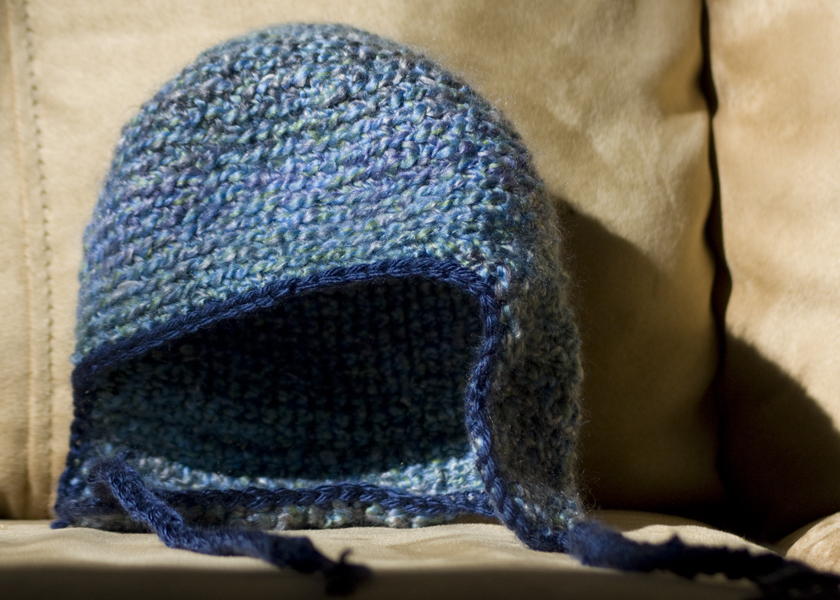
Crocheted a winter hat for the kiddo over the past couple of days. Worked most of it in the round, crocheting into the back loop only, then back and forth to make the back a little longer and add earflaps. Went around the rim with a dark blue yarn to smooth off the edges and create braided ties.
Sunday, October 28, 2012
Baby Pants Alterations
An bit of a tutorial to help you alter store-bought pants to fit over cloth diapers:
You'll need:
-baby pants. make sure they are the length you need and have sufficient stretch in the waistband.
-matching fabric (or not, as suits your fancy)
-scissors
-needle & thread or machine.
Steps:
1. Cut down the back seam of the pants, from the crotch (is that the best word there is?) to the belt loop if there is one, or the yoke or a reasonable stopping point so long as it doesn't interfere with the waistband. I cut on either side of the seam, removing it entirely so that I could have less bulk in my own seams. Additionally, I cut about a half inch out of the top of the inseams.
![]() |
| 1. Cut along seams at center back and inseam, like so. |
2. Carefully, put the pants on the kiddo in question. Let him crawl and stretch and basically move in his usual way. The biggest problem for us with these trim-looking baby pants is that over the cloth diaper they keep him from moving his legs smoothly while crawling, and they pull down the diaper. Neither good. So a main goal of mine for this project was smooth crawling. Most of the area of the pants that needed expansion was in the rump, with just a bit in the crotch to make it wider.
![]() |
| 2, 3, 4. Couldn't get a pic in use, but the gaping was a little like this. |
3. Look/measure/estimate at the amount of gaping that occurs while the kiddo is wearing the pants. I got a general idea of the shape of the gape and measured it at its widest point using my finger. If you can find your tape measure, feel free to do it the proper way. I figured on a tiny bit of extra ease anyway, so didn't want to spend a lot of time measuring.
4. Carefully take the pants back off again.
5. Cut out your second fabric to a bit larger than the hole including seam allowance.
6. Pin the fabric to the pants. I found the easiest way for me was to tuck under the raw edges of the fabric, and pin it from the outside, so both right sides were showing on the outside, as if I were doing an applique. I added a pleat going in either direction at the bottom, where the back panel joins the inseam, so that there could be sufficient expansion in that area as well.
![]() |
| 7. Added fabric basted on. |
![]() |
| 7. View of the pleat at the inseam. |
7. Sew the fabric to the pants. I basted it on by hand for a trial run on the kiddo, with the intention of sewing it more securely by machine at a later point.
8. Press, if you're so inclined. Finish seams if that makes you happy.
This was incredibly quick as projects go, took me about an hour, and that was with me sewing by hand. The results have been excellent--Chubber can crawl freely, and seems more comfortable wearing pants while being carried in the Ergo. Pants that have back pockets may look a little silly, since the pockets get pushed off to the sides.
Hope this helps someone out there in a similar pickle!
Sunday, September 9, 2012
Baby Moccasins
Here's what I made yesterday. Once I actually buckled down to do it, this project was fairly fast. Well it took all day; it wasn't a super concentrated effort, but it all got done in one day. Might have been even faster had I not done everything 100% by hand. Could've saved a few minutes by machine stitching the layers of fabric together, but I decided re-threading the machine and winding the bobbin for such a small project was not worth the hassle for me.
Soles are of leather from Tandy's remnant pile. They are stitched to the upper by waxed linen thread, which is, unfortunately, white, due to a serious lack of options around here.. Vamps and heel quarters are made from a double layer of brown bottomweight twill. Green embroidery thread topstitching for some interest as well as to hold the double layer of fabric together. Hook and loop closures on both sides of the foot for adjustability and ease of use. I had been imagining snaps, but then I imagined how hard that would be to fit and secure, so I changed my mind about snaps on shoes.
![]() |
| (Ignore the too-small, non-matching pants.) |
I think they meet his approval. Hopefully they'll fit for more than a week, since walking isn't quite on our agenda. But when it is, I won't have to worry about the hot, sharp ground. Breathe a sigh of relief.
Saturday, August 25, 2012
Lap Shoulder Shirt
This project is just the beginning for making kid clothes. I basically followed this excellent tutorial over at Made. And when I say "followed", I really mean skimmed the directions to get the gist then wing it like I usually do.
An old black t-shirt hanging around that I never wear, because black just doesn't feel right on me was just begging to be repurposed. Yet more remnants of the blue plaid flannel that makes its appearance all too often were also crying out to be used up for goodness sakes. I wanted to make a t-shirt for F that was longer than his current shirts, since he's got such a long torso. So I traced a onesie that fits, and made sure the length was extra. I took advantage of the existing hem and one side seam of the shirt, leaving them intact. I also kept the sleeve hems for use as sleeves on the little shirt. After cutting out the pieces, I sorta fudged some bias tape for the collar, instead of the ribbing she suggests. The flannel is quite stretchy which is precisely why it didn't get used for its original purpose in the first place. I didn't bother with the ironing board so the tape isn't the straightest or beautifullest. Since this was an experiment in unknown territory (machine sewing knits), I didn't want to waste too much energy, time, or materials. I sewed the bias tape all wobbly along the collar line, then sewed up the side seam, and then the sleeves onto the armholes. Maybe there is a better order to follow so you don't stretch out the sleeves going around the machine's free arm or whatever that's called. (Can't you tell I'm a super technical sewist? You'll laugh when you hear I've been omitting a step on threading my machine for 10 years now. Clearly it's not critical.) And that was it for this super simple garment... I'll do better next time, hopefully.
The sleeves are actually an all right size, but the shirt is a little wider than intended. It is incredibly easy to get over his head, and really, isn't that all that matters?
An old black t-shirt hanging around that I never wear, because black just doesn't feel right on me was just begging to be repurposed. Yet more remnants of the blue plaid flannel that makes its appearance all too often were also crying out to be used up for goodness sakes. I wanted to make a t-shirt for F that was longer than his current shirts, since he's got such a long torso. So I traced a onesie that fits, and made sure the length was extra. I took advantage of the existing hem and one side seam of the shirt, leaving them intact. I also kept the sleeve hems for use as sleeves on the little shirt. After cutting out the pieces, I sorta fudged some bias tape for the collar, instead of the ribbing she suggests. The flannel is quite stretchy which is precisely why it didn't get used for its original purpose in the first place. I didn't bother with the ironing board so the tape isn't the straightest or beautifullest. Since this was an experiment in unknown territory (machine sewing knits), I didn't want to waste too much energy, time, or materials. I sewed the bias tape all wobbly along the collar line, then sewed up the side seam, and then the sleeves onto the armholes. Maybe there is a better order to follow so you don't stretch out the sleeves going around the machine's free arm or whatever that's called. (Can't you tell I'm a super technical sewist? You'll laugh when you hear I've been omitting a step on threading my machine for 10 years now. Clearly it's not critical.) And that was it for this super simple garment... I'll do better next time, hopefully.
The sleeves are actually an all right size, but the shirt is a little wider than intended. It is incredibly easy to get over his head, and really, isn't that all that matters?
Subscribe to:
Comments (Atom)