}

Pages

Showing posts with label diapers. Show all posts

Monday, November 5, 2012

Knitted Longies

Now that we've had a shift in weather towards cooler than sweltering, I'm thinking about our warm clothes wardrobe.  And we need some longies.  Woolen pants to wear over a diaper.  Once lanolized, they are not exactly waterproof, but water doesn't get through them, since one of the coolest things about wool is the amount of water it can hold before feeling wet.  And water is the least of our worries, right, folks?

Method:
For these I started out by casting on 108 stitches using the cable cast-on method.  This is pretty much where my technicality withers into a mishmash of knowing what I'm doing and guesswork, so if you were thinking you could follow this pattern mindlessly, you can think again.  If however you don't have any interest in knitting jargon, you can go ahead and skip to the pictures.  Then I made ribbing (K2P2) for some number of rows that felt right.  Then went back to regular knitting for a while, then decided to do a row of purling on the knit side, which is how I got that thin stripe.  Then maybe 3 rows of knitting, then I started the moss or seed stitch, which is just offset purls and knits so they make a tile pattern.  Then I kept on knitting for a bit until I felt the need for more thin stripes, and continued until the length of the piece I had seemed sufficiently long.  I based this length off our current (boughten) wool soaker.  I made a gusset as shown in this pattern.  It went okay, but probably not as well as it might have if I knew what the heck I was doing.  I might have already made the rise too tall, so I cut the gusset a bit shorter than I might have.  Probably not the wisest decision.  Then I began the legs by dividing the row in half, inserting a lifeline to hold the half I wasn't currently working on, transferring the half I was working on onto double pointed needles and working in the round down to the bottom cuff, which was more K2P2 ribbing.  I cast off, went back and did the other leg.  

Things I discovered while doing this project: 
While looking up how to do a stretchy cast on and seed stitch, I found out that there are two kinds of knitting: Continental style in which the yarn leading to the ball is held taut in your left hand, and English style, in which the yarn is held taut in your right hand.  Due to the mechanics of this and how you have to switch your yarn from front to back to change between knitting and purling, ribbing goes a lot faster if you are using the Continental method, though it is less forgiving of correct tension than English.  What I found out about myself was that in my prior ignorance, I had already been doing Continental purling, and English knitting, to balance the work between my hands for their relief.  It took a while but I taught myself how to knit from the Continental side so I could do this speedy ribbing (or seed stitch).  I still switch back to English knitting if I'm doing a whole row.  Now I'm getting the hang of the Continental, and really prefer it. 


The results:
 
Knit longies.
Now I've seen them on, I am super pleased with the way they came out, and the rise height and leg length are just right.  

A trial run.


Sunday, September 23, 2012

Keep Tie-dye Weird

Ugh, how I hate the word.  Tie-dye.  It makes me think of hideous too-bright rainbow swirls and "Keep Austin Weird" emblazoned on an ill-fitting touristy t-shirt.  It's become so mainstream that nothing about them screams particularly weird.  Shops and even other places have assimilated the design into their cultures, and now they're everywhere you look, from football games to truck stops.

But why should I let that make me hate the word tie-dye?  I like some tie dye, and it is as succinct and accurate a description of the process as you could imagine.  You tie something up, then you dye it.  Easy.  Depending on how you tie and how much dye you use and where you put it, you can get infinite variations.  You don't have to use the rainbow swirl, you can make bunch of brown wavy pleats if you so choose.  And the process is fun.  

I've always enjoyed the process more than wearing the finished project, although way back in middle school I made a bandana with these cool dyed strings, so instead of using the strings as resist, they were making the color. At the time, wearing a headscarf was all the rage, so I wore my bandana to school alot.  I even got called to the office for my "gang symbol".  Right.  The gang of hippie tie-dyer kids.  Who regularly got smashed against lockers on our way to ACE classes, or art class, or maybe woodwind rehearsal.  There may even have been some of us in the Extreme Reading elective.  But I'm not sure, since we were merely a loosely formed band of kiddos who were concerned about whether or not we might get caught in the crossfire of a saloon brawl at lunch.  That being said, we were a huge threat to all the even titchier or even dweebier kids, mostly due to our prayers that the thugs would beat them up instead.  I still have that now-faded bandana. 

But I digress.  My point is actually how much I love dyeing things.  Resist-dyeing things.  

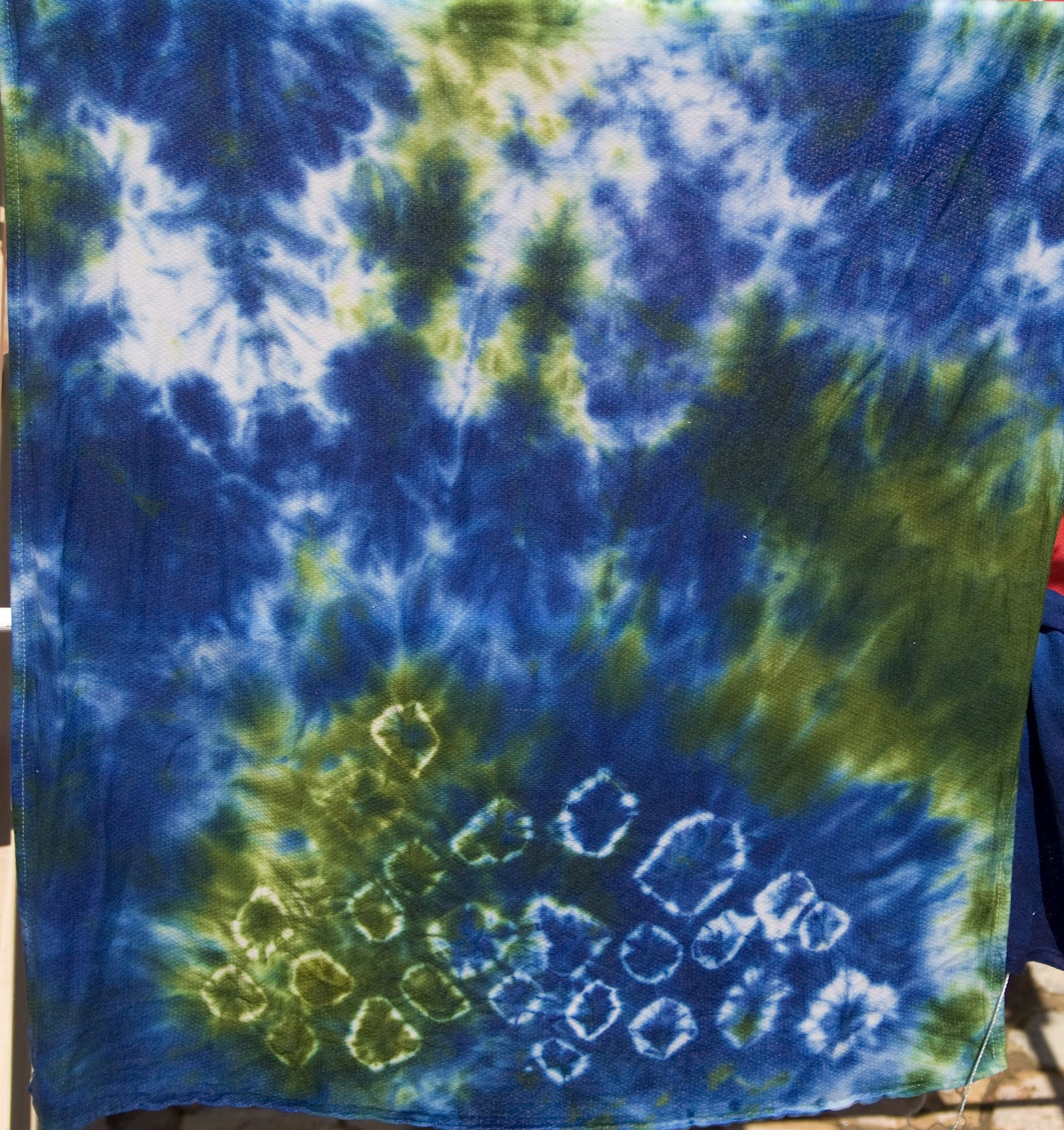
Yesterday, I dyed these diapers for my "more diaper mods" project.  My intention was to end up with one color on the inside of the circle and another for the background. 
  

My first attempt at dripping dye into the tufts created by the ties was a catastrophe.  The dye got everywhere, including my hands.  I had also tied some big tufts with rubber bands just to see.


The next attempt, I was trying to dye the entire thing first and then color the tufts.  It still didn't work well, so I just aimed for a more even dye all over.


For this piece, I wanted more white in the background since I could tell the blue had mixed up pretty dark.  So I crumpled up the cloth in the plastic bag it would sit in, and splashed dye over the top without worrying about getting much on the bottom.


By the time I got to the last piece I had a technique that seemed to work.  I put the green dye in a plate and dipped the tufts into it.  They were close together so it was hard to get them individually but they were also different lengths so I couldn't get them all in at once.  I had to do a couple at a time, which was more time consuming than I'd like without being as neat as I really wanted.  I then overdyed it all blue.   

I like how they all came out, these weird tie-dyes. 

Wednesday, September 19, 2012

More Diaper Mods


Flats are no longer doing it for me.  They are great in the early days, but getting them folded to just the right length and putting them into the cover just so, and getting it on a baby who is desperately trying to get away... I'm over it.  So my flats need a new purpose.  A diapering purpose so that I don't need to buy any more diapers.  

Initially this project was an attempt to make my flats into fitteds.  But the elastic gathering in the legs was really a hassle.  I made a lovely casing, but it was just too bulky to really snug up with elastic.  Look, it's terrible, right?  We can either blame the number of layers of fabric or the burnt-out-ness of the elastic--I salvaged it from an old, ill-fitting item of clothing.  At least I didn't waste new elastic on this endeavor.

Gathering is not occurring.

So I think I will sidle over into slightly different territory and not worry about the elasticated legs, but make this more like a contour diaper.  We'll see how that works instead.  

I may even try to make different thicknesses of diapers, (maybe somehow labelled with different colored threads to discern which is which) so that they can serve different purposes.  Another twist I'm planning is to dye the outer layer of the diaper (but not the inner) before sewing it for colorful coverless times.

Here's the prototype in the testing stage.  I already have a few modifications planned to make the fit around the legs better. 


Monday, September 17, 2012

Diaper Tabs

What do you do when you have a baby who's too rotund for size large prefolds?  Add tabs!  

For the prototype for the tabbed diapers, I used some old blue plaid flannel.  There wasn't a long enough strip to go entirely across the back of the diaper, so I split it in the middle.  Also I was being cheap thrifty and trying to use up some yellow and green thread that I have too much of.  Yeah, you can really tell this was a first attempt.

The prototype.

For the next set of tabs I opted to use 2 birdseye flats, each cut into thirds, sewn into tubes and then sewn across the top edge of the back of the diaper.  Not only is this spiffier looking, but it gives me the advantage of an extra inch or so of diaper length.  Why take measures to extend width-wise and neglect length, right?  These diapers are definitely a step up from the flannel prototype.  I decided that plain old birdseye just wasn't cool enough, so I dyed them with the Ice dyeing method.

Some of the ice-dyed tabs.

In use.

That worked out so well that I decided to dye another couple of flats to make more tabs.  For these I tried out shibori.  They kinda look like the patterns on the bottom of a pool. 

Shibori tabs.


An additional, unlooked-for advantage of these tabs is that they're considerably easier to get pins through, since they're just two layers of a looser weave.  The advantage of pins over snappis is that pins actually manage to hold the diaper on a mobile baby if you're not using a cover.  Leaving your pins stuck in a bar of soap is a good way to keep them sliding through the diaper easily.  Hmmm...that gives me an idea for another project!  

Monday, August 20, 2012

Shibori

I've been playing around with lots of dyeing methods lately.  Ultimately this dye project will become more diaper tabs.  So I have sacrificed two birdseye flats as the next dye victims.
Shibori around xeriscaping.

We have a lot of rocks around here, so I figured it would be cool to try a couple of different methods of shibori.  One is called kanoko shibori (at least I think that's what I did, though honestly the name's not so important), which is basically the same as tie-dye you think of with all the colors.  I chose to put rubberbands around the rock pouches to create a pebbly effect.  Then I ran out of rubberbands and just decided to tie with string in small tufts.  This sounds tedious, but is actually somewhat relaxing.


Shibori around olive oil bottle.

For this iteration, I have done the tieing in the arashi shibori method.  Arashi means "storm" and by wrapping the cloth around something on the diagonal, it creates the effect of a driving rain.  I wrapped rubber bands around the top and bottom to keep the fabric from slipping right off the ends, and the string for the real resist ties.


Rub-a-dub-dub.

Here they are in the dyebath.  Traditionally, I believe this is done in indigo, and maybe one day I'll do indigo dyeing, but right now, just plain ole' Procion Mx dyes are the ones for me.  I''m using Dharma's Royal Blue.
 

Here is the rock part un-banded, with the string ties still tied.  
 

The rock and string fabric, untied and rinsed of excess dye and soda ash.  I like the way it came out.

Here is the arashi, untied and rinsed.  It came out a little wonky, not so much like rain as like a waterfall.  Next time, a taller thing to wrap around would probably be better.  

So I guess they came out well for a first try, we'll see once they are fully washed in hot water.  I guess they probably won't look as cool once they're cut into strips, but you better believe they'll still be the coolest diapers around.

Update: a lot of the dye came out in the hot wash, so the blue is less vivid, now. 

Monday, August 13, 2012

Ice Dyeing

When I saw instructions for this technique, what with it being a zillion degrees outside, and us often having ice leftover in our cooler from getting groceries, it seemed like something I had to try.

After prewashing fabric to remove sizing, oils, etc., I soaked the fabric in soda ash solution.  Next, I crumpled it up (soda ash is caustic, so wear gloves) on top of a coke bottle tray which is upside-down in my trusty large plastic bucket.  This is because I didn't want all the dye water to become murky once the ice melts.  Then, I added ice cubes on top of the fabric.  After that, I sprinkled dye powder on top of the ice cubes.  (Wearing a mask and gloves, because dye powder isn't all that good for you either).  I covered the bucket with its lid to keep the water from evaporating, and bugs from getting in.


Then, wait for the ice to melt.  So, like 15 minutes here...  I waited a few hours to allow the dye to really react with the fabric since I wanted really bright, intense colors that didn't just wash out in the first rinse.  When I came back, it looked like this: 


The yellows didn't seem to be swept away by the ice melting.  And some of that powder that looks yellow is actually green.  

Rinse out excess dye and soda ash with cool water, then wash on hot with soap until rinsewater runs clear.  

Now, for the results.  (Except not the stuff I dyed above, I actually don't have pictures of those, yet).  A random bit of muslin that I felt needed sprucing up, and a half dozen diaper tabs:
Ice-dyed muslin.

Diaper tabs-to-be.